


Stumbled across a repo that does something so obvious I’m shocked it wasn’t everywhere already: a fully open‑source motion capture system that works with any camera. FreeMoCap is a markerless 3D tracking system that runs on ordinary webcams, turning multiple camera feeds into research‑grade skeletal data automatically. 100% open source, no expensive hardware required.
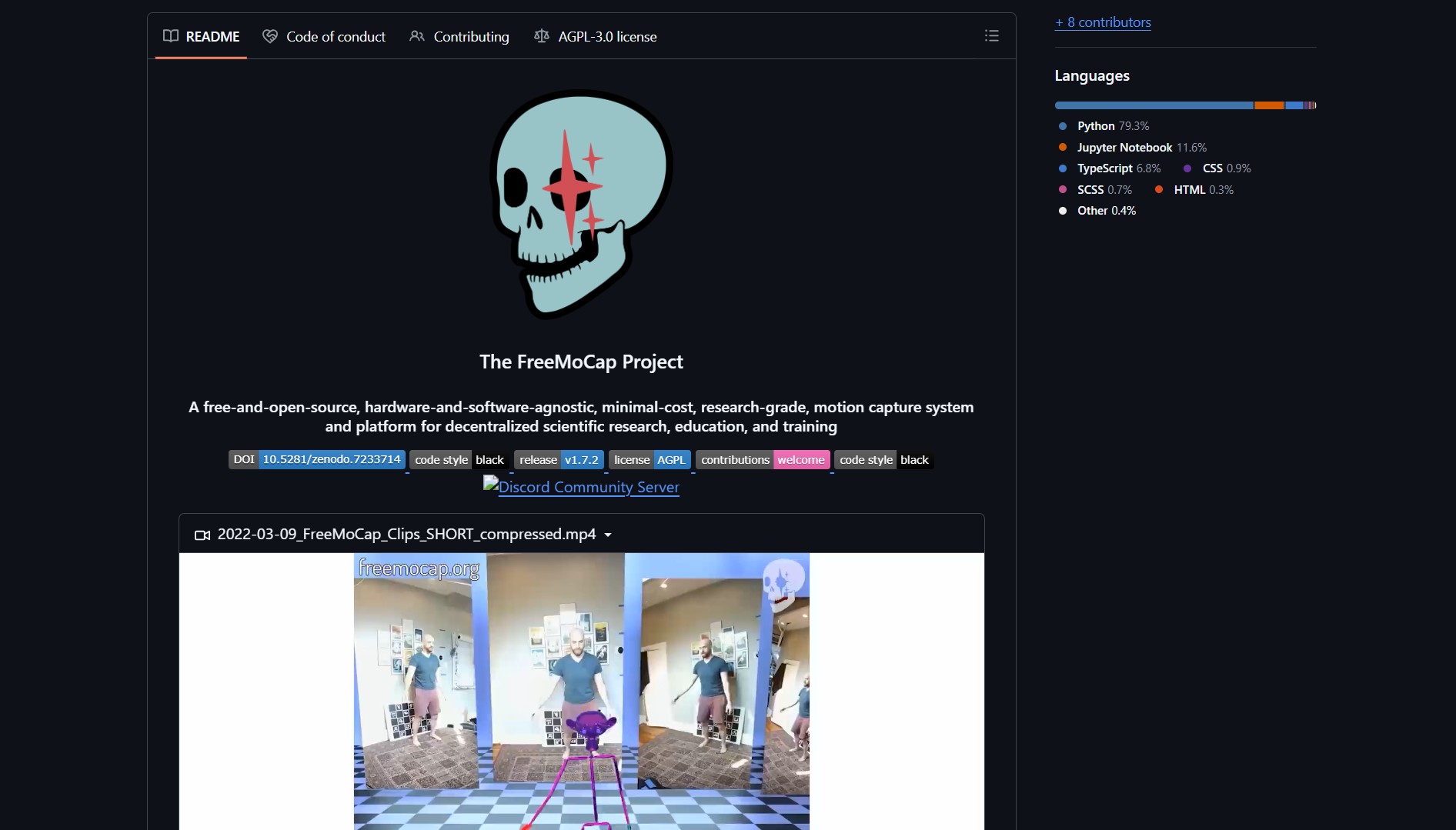 FreeMoCap GitHub repository homepage
FreeMoCap by freemocap is for researchers, creators, and developers who need motion capture without expensive hardware, solving the problem of costly and specialized mocap systems by using ordinary cameras for markerless tracking. The FreeMoCap Project is a free‑and‑open‑source, hardware‑and‑software‑agnostic, minimal‑cost, research‑grade, motion capture system and platform for decentralized scientific research, education, and training.
What Is FreeMoCap?
FreeMoCap is a free‑and‑open‑source motion capture system that uses ordinary cameras (webcams, smartphones, etc.) to perform markerless 3D skeletal tracking. Instead of requiring specialized suits, markers, or depth sensors, it processes multiple 2D video feeds to reconstruct 3D human motion with research‑grade accuracy.
[!NOTE] The system is hardware‑agnostic, meaning it works with any camera setup, from a single webcam to multi‑camera rigs. This makes it accessible to indie creators, researchers on limited budgets, and educators who previously couldn’t afford traditional mocap solutions.
How FreeMoCap Works: Markerless 3D Tracking
| Component | Description |
|---|---|
| Input | Multiple 2D video feeds from ordinary cameras |
| Processing | Computer vision pipelines detect keypoints (joints) in each frame |
| 3D Reconstruction | Multi‑view geometry triangulates 3D positions from 2D detections |
| Output | Time‑series 3D skeletal data (joint positions, rotations) |
| Export Formats | CSV, JSON, BVH, FBX, etc., compatible with Blender, Unity, Unreal |
The pipeline typically involves:
- Camera calibration (intrinsic/extrinsic parameters)
- 2D pose estimation (using models like MediaPipe, OpenPose, etc.)
- 3D triangulation across camera views
- Temporal smoothing and skeleton fitting
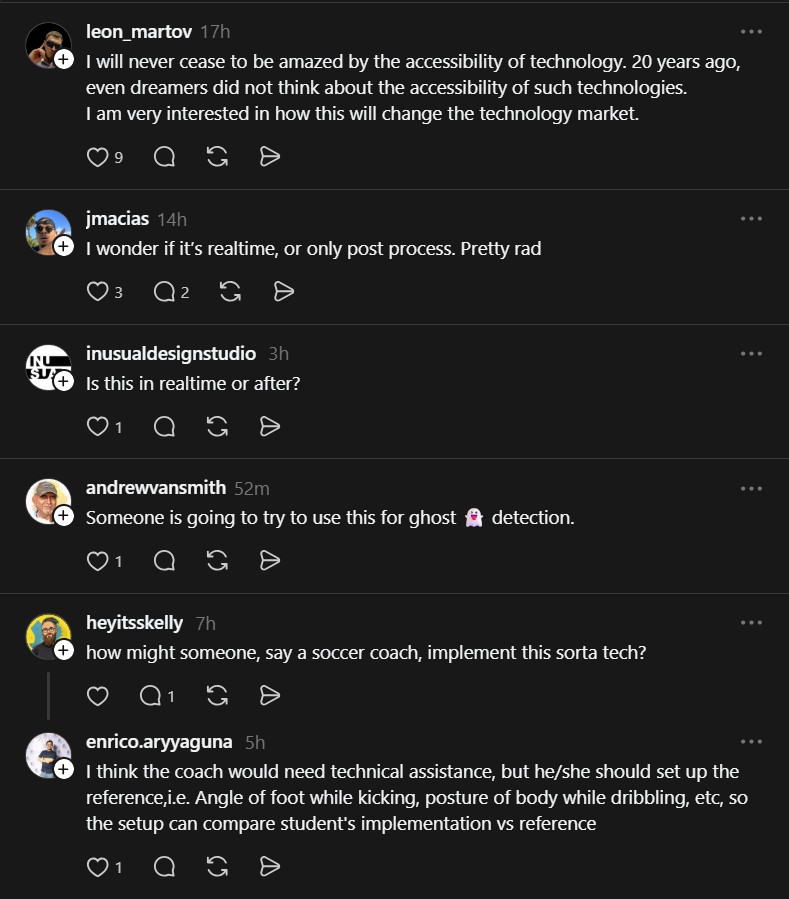 Community discussions about FreeMoCap’s impact
Community Impact & Reactions
“I will never cease to be amazed by the accessibility of technology. 20 years ago, even dreamers did not think about the accessibility of such technologies. I am very interested in how this will change the technology market.” , @leon_martov
“I worked for a markerless motion capture company ten years ago and it was so cutting edge at the time. Now it’s open source with any camera. Crazy.” , @thatguy_3002
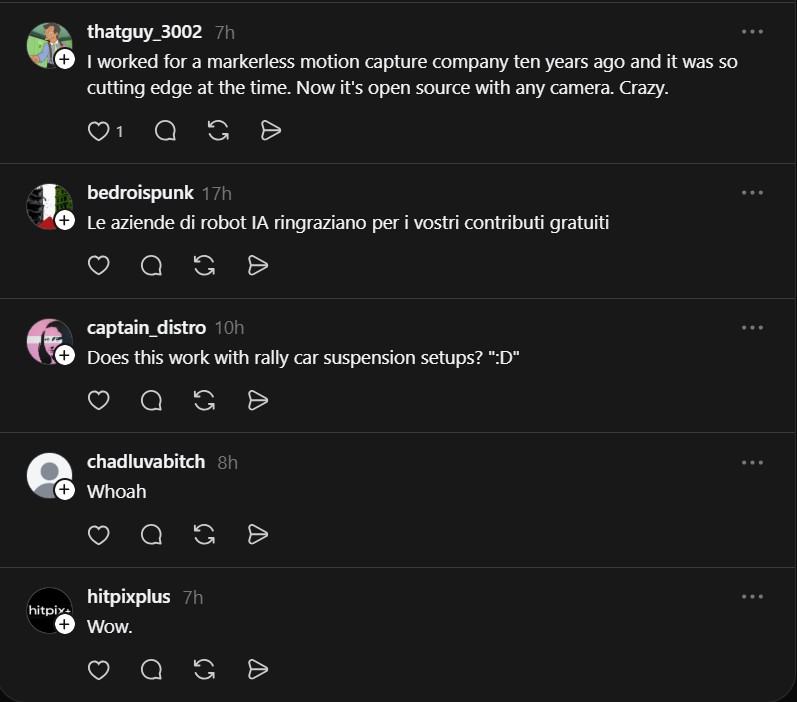 Further reflections on the democratization of motion capture
Why This Democratizes Motion Capture
FreeMoCap removes the three traditional barriers to motion capture: cost, hardware, and expertise. Here’s how that changes the landscape:
- Cost Reduction: From thousands of dollars in specialized equipment to free software and commodity cameras.
- Accessibility: Anyone with a webcam or smartphone can start capturing motion data.
- Research Acceleration: Academic labs and independent researchers can conduct mocap studies without grant‑level funding.
- Educational Tool: Students learn about 3D reconstruction, computer vision, and biomechanics with hands‑on tools.
- Creative Applications: Indie game developers, animators, and digital artists can add professional‑quality mocap to their workflows.
Project Link
FreeMoCap represents a shift in how advanced technology becomes accessible. What was once the domain of well‑funded studios and research institutions is now available to anyone with a camera and a computer, opening up new possibilities for creativity, education, and discovery.
This curation is part of Gitafterwork.com, your daily hub for the best trending GitHub repositories. Bookmark us to stay updated on the tools that actually matter—no fluff, just high-impact open source.