


Stumbled across a repo that does something so obvious I’m shocked it wasn’t everywhere already. Someone just open‑sourced the entire Ivy League math and science curriculum. Stanford, MIT, Harvard.. all of it. In one place. For free.
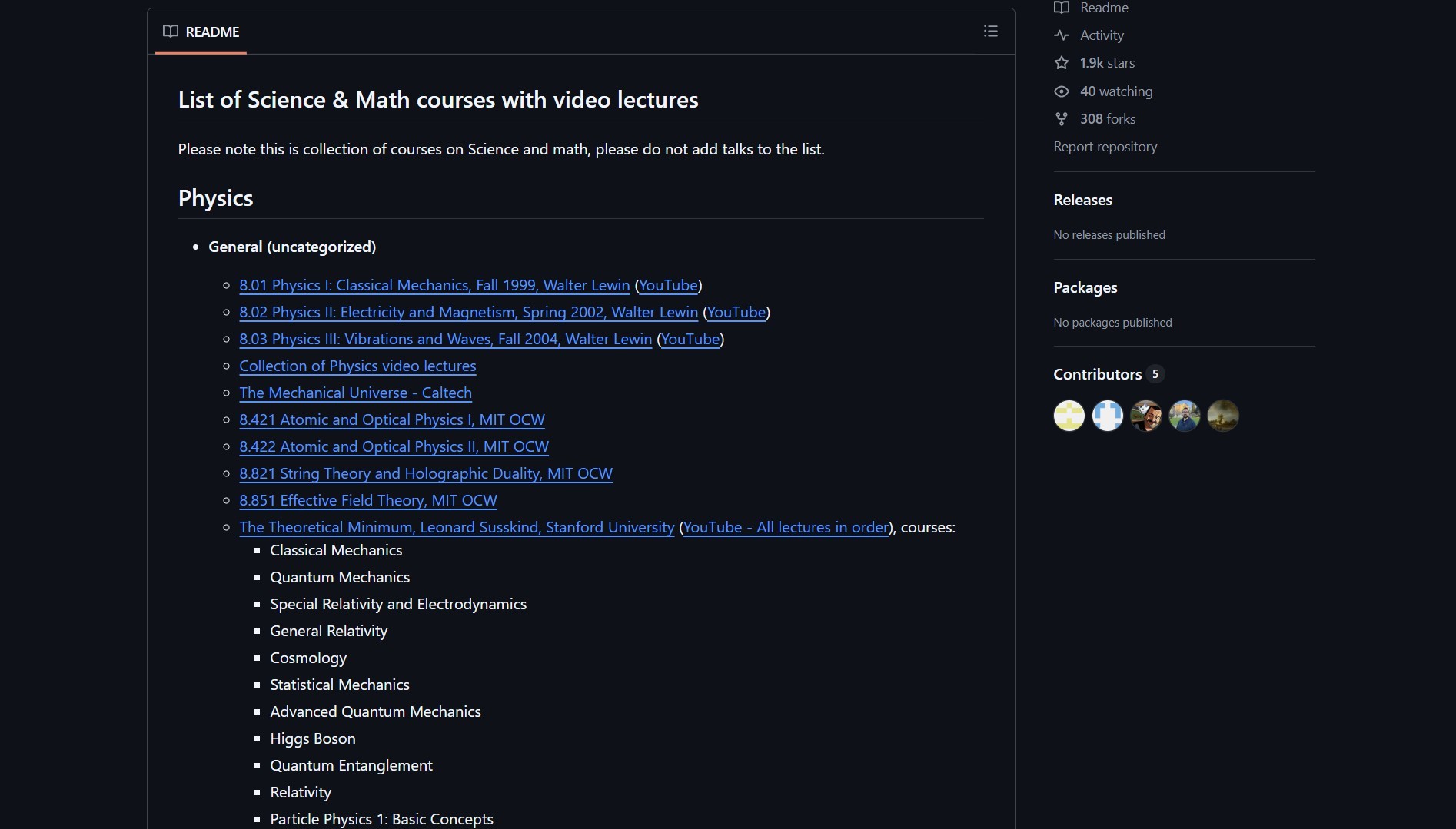 Math Science Video Lectures GitHub repository homepage
math‑science‑video‑lectures is for students and self‑learners, solving the problem of expensive and fragmented education by centralizing top university lectures in one free resource. This collection brings together video lectures from the world’s premier institutions, making elite education accessible to anyone with an internet connection.
What Is Math Science Video Lectures?
Math Science Video Lectures is a curated collection of university‑level video lectures covering mathematics, physics, chemistry, computer science, and engineering from institutions like MIT, Stanford, Harvard, Princeton, Yale, and other top universities. It organizes thousands of hours of instructional content into a structured, searchable repository that’s completely free to access and use.
[!NOTE] Unlike paid platforms like Coursera or edX that offer structured courses with certificates, this repository focuses on raw lecture content, giving learners direct access to the actual classroom experiences of Ivy League institutions without any cost or registration barriers.
Content Coverage & University Sources
| University | Mathematics | Physics | Computer Science | Engineering | Chemistry |
|---|---|---|---|---|---|
| MIT | OpenCourseWare lectures | Physics I‑III | CS50‑style courses | Mechanical, Electrical | General Chemistry |
| Stanford | Linear Algebra, Calculus | Modern Physics | Machine Learning, AI | Civil, Environmental | Organic Chemistry |
| Harvard | Multivariable Calculus | Quantum Mechanics | CS50 (full course) | Biomedical | Physical Chemistry |
| Princeton | Real Analysis | Astrophysics | Algorithms | Chemical Engineering | Inorganic Chemistry |
| Yale | Differential Equations | Thermodynamics | Data Structures | Materials Science | Biochemistry |
Subject Organization & Structure
- Mathematics: Calculus, Linear Algebra, Differential Equations, Real Analysis, Abstract Algebra
- Physics: Classical Mechanics, Quantum Mechanics, Thermodynamics, Electromagnetism, Astrophysics
- Computer Science: Algorithms, Data Structures, Machine Learning, Artificial Intelligence, Programming
- Engineering: Mechanical, Electrical, Civil, Chemical, Biomedical, Materials Science
- Chemistry: General, Organic, Physical, Inorganic, Biochemistry, Analytical
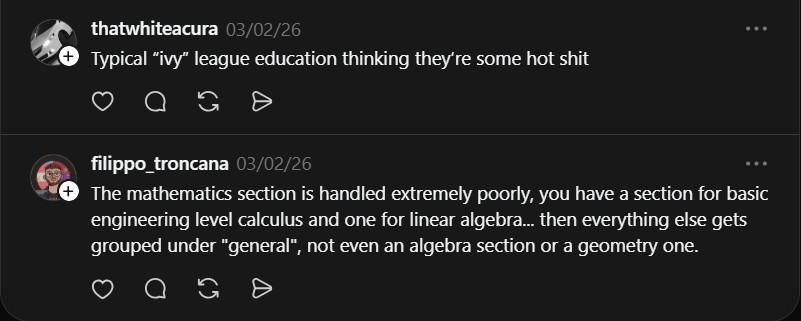 Community discussion about the repository’s organization
Community Feedback & Critical Gaps
“The mathematics section is handled extremely poorly, you have a section for basic engineering level calculus and one for linear algebra… then everything else gets grouped under ““general””, not even an algebra section or a geometry one.” , @filippo_troncana
This critical feedback highlights an important reality: while the repository collects an impressive volume of content, its organization could be improved. The value is in the raw materials, not necessarily in perfect curation. For self‑directed learners willing to navigate the collection, it’s a treasure trove; for those expecting a perfectly structured curriculum, it requires additional effort to organize.
Why This Changes Self‑Directed Learning
Math Science Video Lectures represents a democratization of elite education that was previously unimaginable. Here’s how it transforms access to knowledge:
- Cost Elimination: Removes the $50,000‑$80,000 annual tuition barrier to Ivy League‑quality education.
- Geographic Access: Makes world‑class instruction available anywhere with internet access, not just in Cambridge or Palo Alto.
- Self‑Paced Learning: Allows learners to progress at their own speed, rewinding and reviewing as needed.
- Curriculum Building: Enables educators to assemble custom learning paths from the best available lectures.
- Lifelong Learning: Supports continuous education beyond traditional university age limits or career stages.
Project Link
This repository proves that the most valuable educational resources aren’t always the most polished or perfectly organized. Sometimes, raw access to great content is more important than perfect packaging. By collecting and open‑sourcing these lectures, the maintainer has created a public good that could potentially educate millions who would otherwise never have access to this level of instruction.