


I fell into a GitHub repo yesterday that solves a problem I didn’t even know was draining my time, and now I can’t stop thinking about it. The CEO of Y Combinator, Garry Tan, just open‑sourced his exact personal AI setup, called gstack. It literally turns Claude Code into a full virtual tech company. You get distinct AI personas like a CEO, Engineering Manager, and QA tester. The best part? A conductor agent forces the AI to think strategically before writing a single line of code. Ship software like the head of YC.
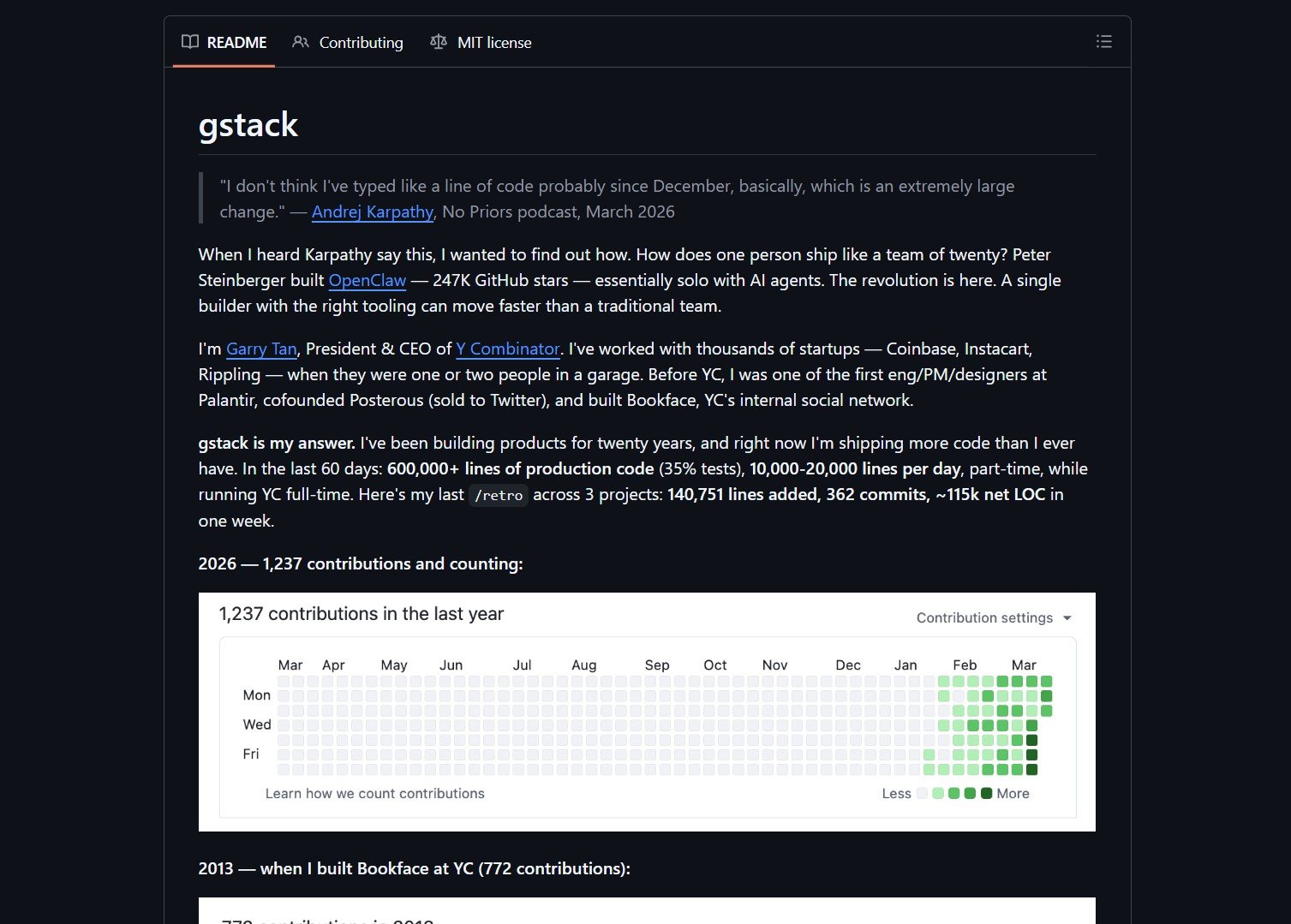 gstack GitHub repository homepage
gstack is for builders and developers who want to scale software creation with AI teams, solving the problem of unstructured solo workflows by organizing AI into coordinated, role‑based agents. As Garry Tan himself states: “I’m Garry Tan, President & CEO of Y Combinator. I’ve worked with thousands of startups , Coinbase, Instacart, Rippling , when they were one or two people in a garage. Before YC, I was one of the first eng/PM/designers at Palantir, cofounded Posterous (sold to Twitter), and built Bookface, YC’s internal social network.”
What Is Gstack?
gstack is Garry Tan’s answer to scaling software development with AI. He explains: “I’ve been building products for twenty years, and right now I’m shipping more code than I ever have. In the last 60 days: 600,000+ lines of production code (35% tests), 10,000‑20,000 lines per day, part‑time, while running YC full‑time. Here’s my last /retro across 3 projects: 140,751 lines added, 362 commits, ,115k net LOC in one week.”
[!NOTE] Unlike solo AI coding assistants that operate in isolation, gstack creates a complete virtual organization with specialized roles that collaborate, review each other’s work, and maintain strategic alignment through a conductor agent.
How Gstack Works: AI Roles & Orchestration
| Role | Responsibility |
|---|---|
| Conductor Agent | Forces strategic thinking before coding begins, coordinates all other agents |
| CEO Persona | Sets overall vision, priorities, and business objectives |
| Engineering Manager | Breaks down tasks, manages timelines, ensures technical feasibility |
| QA Tester | Reviews code for bugs, edge cases, and quality standards |
| Individual Contributors | Write actual implementation code based on assigned tasks |
The Conductor Agent Difference
The conductor agent is what separates gstack from other AI coding tools. Instead of jumping straight to implementation, it enforces a planning phase where:
- Problem Analysis: The AI must fully understand the problem before proposing solutions.
- Strategic Planning: It considers multiple approaches and evaluates trade‑offs.
- Role Assignment: It determines which AI personas should handle which parts of the task.
- Implementation Sequencing: It creates a logical order for building components.
- Review Coordination: It ensures proper QA and review cycles happen.
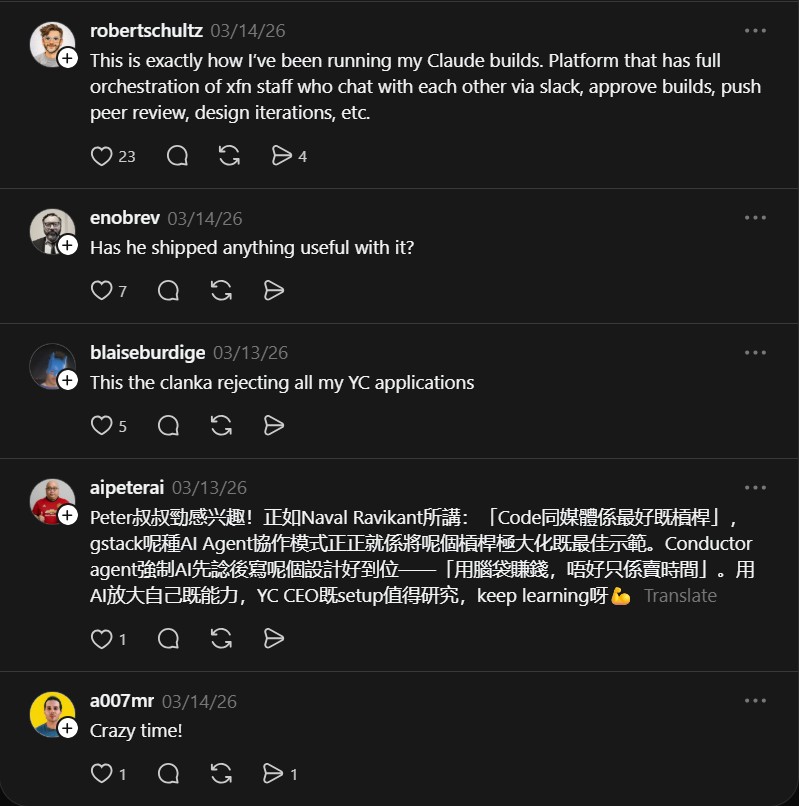 Community discussion about gstack’s orchestration approach
Community Validation & Parallel Approaches
“This is exactly how I’ve been running my Claude builds. Platform that has full orchestration of xfn staff who chat with each other via slack, approve builds, push peer review, design iterations, etc.” , @robertschultz
This comment validates the core insight: successful AI‑assisted development requires orchestration, not just more powerful individual agents. Teams, even virtual ones, outperform solo actors.
Why This Changes AI‑Assisted Software Development
gstack represents a fundamental shift from AI as a coding assistant to AI as a development organization. Here’s how it transforms the workflow:
- Strategic Discipline: Forces planning before implementation, reducing rework and technical debt.
- Role Specialization: Different AI personas excel at different aspects of development (strategy vs. implementation vs. testing).
- Scalable Output: Enables one developer to produce at the volume of a small team while maintaining quality.
- Reduced Cognitive Load: The conductor agent manages coordination, letting developers focus on high‑level direction.
- Enterprise‑Grade Process: Brings startup‑scale agility with enterprise‑level process rigor.
[!TIP] Enhance with: Claude-peers-mcp — sync multi-window agent communication.
Dig deeper: Claw Code — the Rust-based harness powering flagship AI agents.
Project Link
gstack proves that the next frontier in AI‑assisted development isn’t better individual agents, but better coordination between them. By modeling how successful human teams work, rather than trying to create a single super‑coder, it unlocks production‑scale software development for individual builders.